
Three Tests Before You Launch a Separate AI Product
· Hui Huang
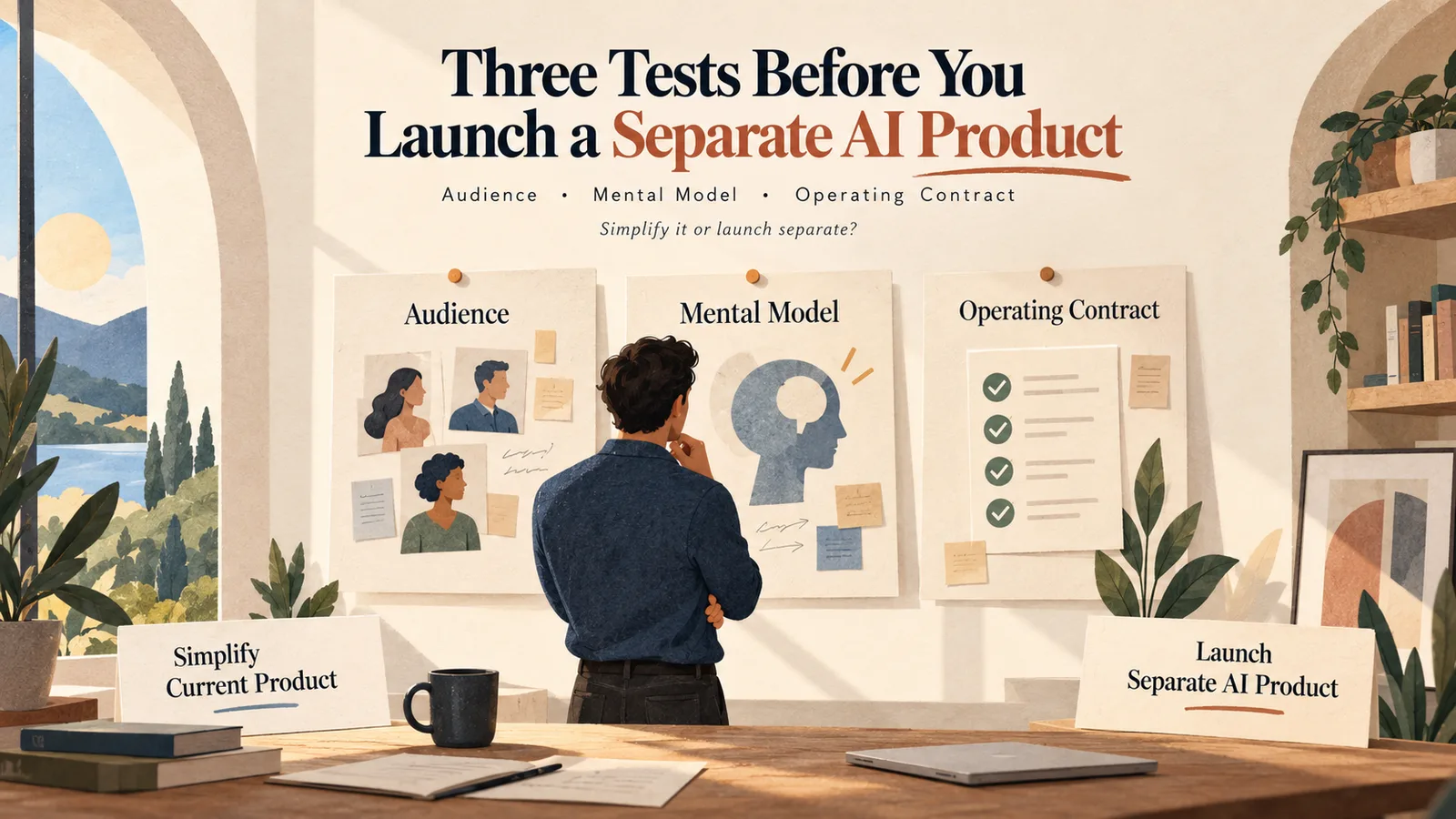
Why do some excellent AI products struggle to reach new users, even after the team makes them easier to use?
Often it’s because the product got very good at serving one audience. Its language, navigation, reputation, and quiet assumptions about what a capable user already knows all fit that audience. To everyone else, those same strengths say “not for you.”
That leaves growing AI companies with an awkward choice. When a powerful tool draws interest beyond its original market, do you simplify the existing product or build a new one? The usual answer is to reduce friction. But sometimes friction isn’t the problem. The user is arriving at the wrong door.
When your brand already answered the question
Cursor’s move beyond coding is a useful case. Cursor built its name on developer workflows. In August 2026 it launched Grok Bot, a separate product for handing work to AI teammates. Its public materials describe bots with their own persistent computers that work across apps and come back when they need a human’s approval. That’s a different way in than an editor where a developer directs an agent through code.
The difference isn’t fewer buttons. The two products start from different assumptions. A coding agent lives inside a developer’s environment, where files, terminals, repositories, and diffs are the natural things to look at. A general work agent has to start with an assignment: what outcome you need, which tools it can touch, how much authority it has, and when it should stop for review.
A nontechnical user may never reach a coding product’s improved onboarding. The brand and the first screen have already told them, rightly or wrongly, that it’s a tool for someone else. Polishing the instructions inside solves a later problem, not the first one.
That’s why brand baggage is more than a marketing issue. A brand is a shortcut in the customer’s head for what the product is. The shortcut saves time when it fits. It works against you when you want to tell a very different story.
Easier to use vs. easier to understand
Teams talk about simplicity as one goal. It’s really two.
Operational simplicity cuts steps, controls, and confusion inside a workflow people already understand. It asks: can we make this easier to operate?
Conceptual simplicity changes the mental model a person needs before the workflow makes sense. It asks: why should this person have to think about the problem in these terms at all?
Picture an agent platform organized around projects, tools, models, execution states, and logs. A developer values those controls because each maps to a real way things break. An operations manager who wants a weekly vendor reconciliation asks different questions. What gets checked? Which records are the source of truth? What happens on a mismatch? Can I approve the result before anything goes out?
Friendlier labels help, but the structure underneath still shapes the experience. When every decision is arranged around the system’s machinery, you’re asking the user to learn the builder’s architecture. A new product can arrange the same capabilities around outcomes, evidence, permissions, and exceptions.
You don’t need to rewrite the technology, and you probably shouldn’t. A fresh start resets the deal with the user, not the proven parts underneath.
Three tests before you build a second product
A new product is expensive. It means more distribution work, more support, separate sign-in flows, new pricing questions, and attention split between two experiences. A fresh brand can’t rescue a fuzzy customer problem, and not every request from a nearby segment deserves its own app.
Run three tests first.
- The audience test. Are new users doing a fundamentally different job, or the same job with less expertise? If it’s the same job, better defaults and revealing advanced options gradually may be enough. If what counts as success changes, a separate product starts to make sense.
- The mental-model test. Can the new experience make sense without constantly explaining the original product’s concepts? Ask first-time users what they think the product does before you show them. If they keep putting it in the wrong category, the problem starts before usability.
- The operating-contract test. Does the new audience need different permissions, review points, evidence, reliability standards, or ownership of results? A coding assistant optimizes for a fast loop of instruct, run, and check. A business assistant you delegate to has to finish work reliably across systems while keeping a human clearly in charge. That’s more than a different screen layout.
The output should be a reversible experiment, not a grand rewrite. Build a thin, separate experience on shared infrastructure. Give it its own job, vocabulary, onboarding, and success measure. Keep it small enough that a weak result doesn’t eat the whole company.
Why a top-down push can help
An order from leadership to explore a separate direction can feel arbitrary, especially to a team invested in improving the current product. But leaders sometimes see a boundary that step-by-step optimization hides. Each improvement makes sense on its own while locking the product deeper into the wrong organizing idea for a new market.
The value isn’t the authority. It’s permission to question what the roadmap treats as fixed. The team still needs evidence. Judge the prototype by whether unfamiliar users understand the promise, finish real tasks, come back without hand-holding, and trust the results, not by whether the demo looks dramatically simpler.
This matters even more for AI products, where a good demo and dependable delegation are far apart. A system that looks effortless but leaves users checking everything by hand has just hidden its complexity. Real simplicity includes the ability to inspect evidence, limit authority, fix mistakes, and pick work back up.
A new door, not another maze
This line of questioning has three valid outcomes:
- Improve the existing product if the job and mental model are shared.
- Add a separate entry point on the same platform if the audience needs a different front door but the operating contract is similar.
- Build a separate product when the promise, workflow, and trust requirements diverge enough that one interface would weaken both.
The mistake is assuming that making a tool easier automatically makes it more relevant. Ease helps people cross the threshold. Relevance decides whether they want to.
So don’t just ask whether the old house can be renovated. Ask whether the people you want to serve see it as a place meant for them.
If you’re deciding how to bring AI to a new audience inside your company, see how we approach Deployable AI.
Sources: Cursor’s Grok Bot announcement (August 11, 2026); Cursor documentation on Grok Bot; Grok Bot launch announcement.
Stay Updated
Get notified when we publish new insights on AI transformation